
Why Progress Often Feels Invisible in Dog Behaviour Change
Why Behaviour Change Takes Time

One of the most common things guardians say to me during behaviour work is:
“It doesn’t feel like we’re making progress.”
And I completely understand why it feels that way.
When you’re living with your dog every day, progress doesn’t always arrive in big, obvious moments. Instead, it tends to appear quietly, gradually, and sometimes so subtly that it’s easy to miss.
But that doesn’t mean nothing is changing.
In fact, some of the most meaningful progress in behaviour work happens in ways that are almost invisible at first.
Behaviour Change Rarely Happens in Straight Lines
Many people imagine training progress as something that looks like a straight upward line.
Improve a little.
Improve a bit more.
Then suddenly everything works.
But behaviour change rarely works like that.
Real progress tends to look more like:
• Small improvements
• Plateaus
• Temporary setbacks
• Another small improvement
• Then suddenly a breakthrough
Dogs are learning, processing, regulating their emotions, and adapting to new experiences all at the same time. That takes time.
And just like humans, dogs don’t learn in perfectly predictable patterns.
Emotional Learning Happens Beneath the Surface
When we support dogs with challenges such as:
reactivity
fear
separation anxiety
frustration
trauma histories
we’re not simply teaching behaviours.
We’re helping the dog change how they feel about something.
And emotional change happens much more slowly than simple skill learning.
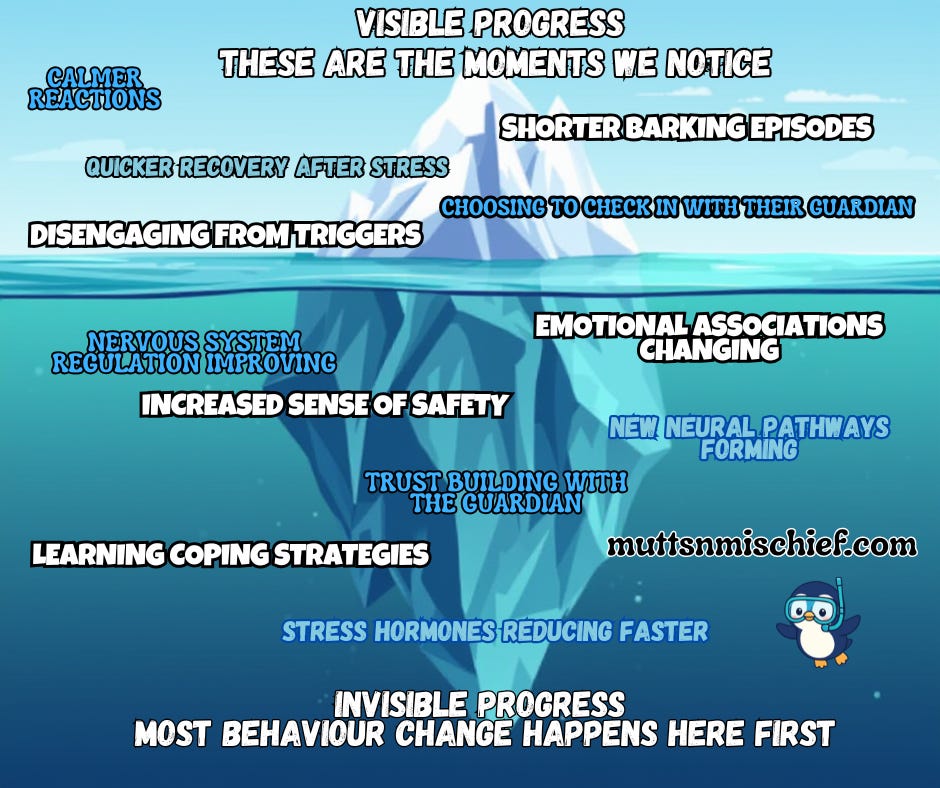
A dog may look the same on the outside for a while, but internally their nervous system may be learning:
• that the world feels safer
• that they can cope with stress
• that they have more choices
• that their guardian understands them
Those internal shifts take time to become visible in behaviour.
The Brain Needs Repetition to Rewire
Neuroscience shows us that learning involves building and strengthening neural pathways.
Every calm exposure, every successful experience, and every moment where the dog feels safe helps strengthen those pathways.
But the brain needs repetition.
Lots of repetition.
It’s a bit like walking through tall grass.
The first time you walk through, you can barely see a path.
But if you walk the same route again and again, eventually a clear path appears.
Behaviour change works the same way.
From a neuroscience perspective, behaviour change involves the gradual strengthening of neural pathways. Each safe exposure, each moment of co-regulation, and each successful recovery from stress adds another layer of learning.
This process is slow because emotional learning involves several brain systems working together.
The amygdala is monitoring safety.
The hippocampus is forming memories of experiences.
The prefrontal cortex gradually learns to regulate responses.
When dogs repeatedly experience situations where they feel supported rather than overwhelmed, the brain slowly begins to reinterpret those situations as safer.
But this rewiring process takes time.
Progress Often Appears as “Tiny Wins”
Some of the most important improvements don’t look dramatic.
They might look like:
• Your dog noticing a trigger but not reacting as strongly
• Recovering faster after being startled
• Choosing to look at you instead of the environment
• Settling more easily at home
• Being able to disengage sooner
These are subtle signals that the nervous system is learning.
They may feel insignificant in the moment, but they represent something profound: the dog’s internal experience is beginning to change.
They are often huge steps in emotional development.
Familiarity Makes Progress Harder to Notice
Another reason progress feels invisible is something psychologists call the familiarity effect.
When we see something every day, our brain stops noticing gradual change.
Think about how you might not notice a puppy growing week by week — but someone who hasn’t seen them in months will immediately say:
“They’ve grown so much!”
Behaviour change can feel exactly the same.
Sometimes it’s only when we look back at old videos, notes, or training journals that we realise how far a dog has actually come.
Stress and Fatigue Can Hide Progress Too
When guardians are tired, overwhelmed, or worried about their dog, it can be very hard to notice subtle improvements.
And that’s completely understandable.
Supporting a sensitive or reactive dog can be emotionally demanding.
This is one reason why keeping small notes or a progress journal can be so helpful.
It allows you to see the pattern of change over time, rather than judging progress based on one difficult day.
One Difficult Day Does Not Erase Progress
Dogs — like humans — have off days.
A stressful walk, a surprise trigger, a loud noise, or an unexpected event can temporarily push behaviour backwards.
But this doesn’t mean the dog has “forgotten everything.”
Learning is still there.
Sometimes the nervous system simply needs a little time to settle again.
Progress is not erased by a single setback.
What Progress Actually Looks Like
Over time, the changes often begin to add up.
The dog may begin to:
• recover faster after stress
• make calmer choices
• seek guidance from their guardian
• show curiosity instead of fear
• feel safer in the world
And sometimes one day you suddenly realise something surprising:
“That thing that used to be really difficult… hasn’t happened in weeks.”
That’s when all those invisible steps suddenly become visible.
A Gentle Reminder for Guardians
If you’re working through behaviour challenges with your dog, please remember:
Progress doesn’t have to be dramatic to be meaningful.
Sometimes the most powerful changes are the quiet ones.
The small moments of calm.
The quicker recoveries.
The growing trust between you and your dog.
Those moments are the foundations of lasting change.
And even if it doesn’t always feel like it…
Progress is often happening long before we can see it.
✦ Behaviour makes more sense when we understand the nervous system.